

Foreword
This book began as a joke.
It all started on my 26th birthday. I was sitting with my father and mother for lunch at an Italian restaurant around the corner from my place. In that moment I could not see the significance as I can today. Today I am aware of finiteness, and this became especially clear to me through this book.
When my father asked whether I had a birthday wish, I answered: a book.
I didn’t mean it entirely seriously. It was more a thought that sounded nice in that moment: a memory, something lasting. Something that might still be there when we ourselves are long gone. Who would have thought it would come true so quickly.
My father waved it off. He laughed and said he didn’t even know what he should write about. Besides, he wasn’t a writer. He couldn’t do something like that. But then something happened that I didn’t expect.
Eight months later, I received the first draft in my inbox, completely unexpectedly.
He had actually done it.
Suddenly there was something completely unexpected: pages full of thoughts, memories, explanations. Pages that wanted to be read. Pages I wanted to read.
And then life happened. He no longer found the time to finish this book. Sometimes an illness changes everything faster than you can grasp. Cancer can hit anyone—and sometimes it doesn’t just take health, but also the time to finish things.
That he would write about sailing was, in fact, quite fitting.
Sailing was his passion. Whenever he had the chance, he was drawn to the water—or rather: out onto the water. That’s where he felt good. That’s where he was in his element. For him, sailing wasn’t just a hobby; it was part of who he was.
Perhaps that is why this book is so personal: because it is one of the subjects he didn’t just understand, but lived.
This book is about sailing.
It is meant above all for entertainment and remembrance.
For people who enjoy sailing. For those who may just be getting started—or may become so because of this book.
I should also mention that I am not a writer, and writing is not my profession. This book did not grow out of a desire to create something perfect, but out of the desire to pass something on: thoughts, experiences, and the joy of sailing.
Perhaps that is precisely where its value lies.
Not everything has to be complete to set something in motion. Sometimes it is enough to spark interest, to awaken memories, or to allow the thought of setting the sails oneself.
If this book does exactly that, then it has fulfilled its purpose.
At this point, many books contain a dedication.
This one originally had one too.
My name.
Dedication
For David Dad
Introduction
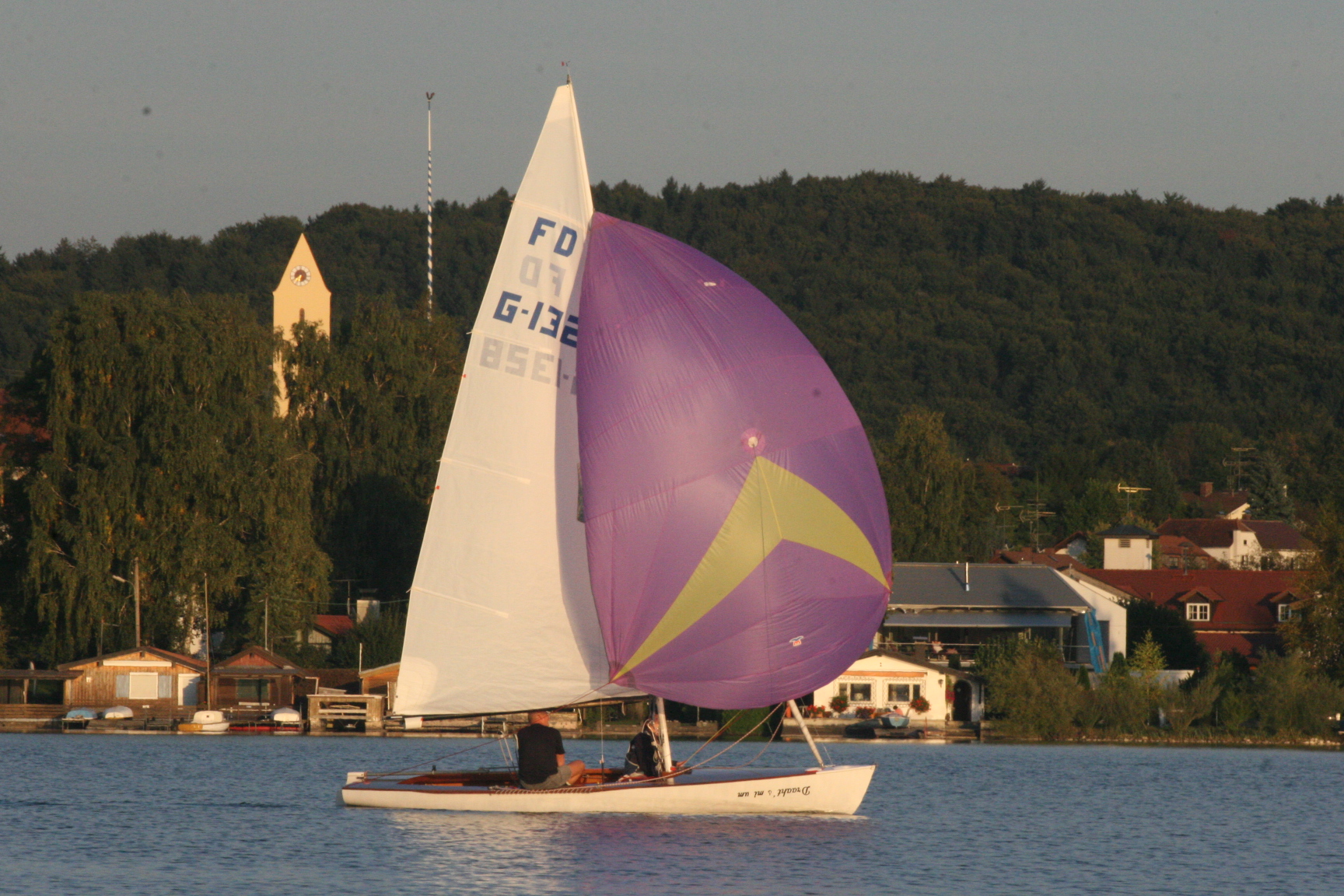
Here you can see the boat with colorful spinnakers. On the front bow, the words “Draahts mi um” are written upside down in black letters.
I started sailing when I was eighteen. Since then it has remained a special balance for me—a pole between relaxation and alertness. Because even when you calm down, you must stay attentive: wind, water, and boat demand presence.
After a while, when experience comes, many things happen almost by themselves. You no longer think through every move consciously. The feeling for the boat, the wind, and the movement is simply there. That is exactly the magical attraction I wanted to describe.
Maybe it will be fun for some to follow along—or even to try it themselves.
Sailing is exciting and in our latitudes usually not particularly dangerous. Still, there are situations where you have to be careful. In the past I even went out in thunderstorms. Today I clearly prefer the shore in such moments.
A thunderstorm is unpredictable: the wind can strengthen or shift within seconds. And a sailboat with an aluminum mast is, unfortunately, an ideal lightning rod on the water. When everything is wet, you are, in the worst case, literally “under power” for a short time—an experience you do not want to repeat.
My own boat is an FD, which stands for Flying Dutchman. It is a very sporty racing dinghy.
A dinghy is a light sailboat without a fixed keel. Unlike larger yachts, a dinghy can capsize if you’re inattentive—it is more agile, but also more lively.
The Flying Dutchman carries about 15 square meters of sail area upwind, plus a colorful spinnaker—a large, belly-shaped foresail for strong downwind—with around 18 square meters.
With a total weight of about 160 kilograms, this boat is among the particularly light and therefore exciting dinghies. The ratio of little weight to lots of sail area makes it fast, sporty, and sometimes challenging.
So my inner prankster brought me to give my boat a very special name:
“ɯn ᴉɯ sʇɥɐɐɹꓷ„
That’s Bavarian and simply means: Turn me around, upside down.
The name is clearly visible on the hull, but upside down. It happens again and again that someone sees the letters, tries to read them, which makes no sense, pauses briefly, tilts their head—and tries again until they grin. Perhaps because it’s different. More playful. Friendlier than many other boat names.
And of course it fits perfectly with an FD. As I said, this boat is lively. Fast, sensitive, sometimes a little stubborn. A small lapse is enough and it can capsize—tips over and ends up upside down. In that moment the name can be read without any contortions.
“Draahts mi um.”
People smile every time.
What fascinates me about sailing is this feeling of catching the power of the wind and turning it into motion. Suddenly, air becomes speed. The boat glides over the water, and behind us a white, foaming trail appears that fascinates anew every time.
The Wörthsee, a small lake near Munich, is a wonderful place for this. In summer it warms quickly and almost automatically invites you to swim. A true home lake—familiar and yet never boring.
Anyone who has ever rowed knows how exhausting it can be to move forward at perhaps eight kilometers per hour. When sailing, nature takes over. The wind carries you—almost silently.
And that is exactly it: sailing is quiet.
No engine noise. No smell on the water. No constant refueling. Motorboats, on the other hand, often seem hectic, loud, and on many Bavarian lakes also complicated.
Sailing is the opposite for me.
Just go out when time allows. Light. Still. And free.
Why a Boat Can Sail Without an Engine
Something that fascinated me about sailing was how the sailboats glided almost silently across the lake. No engine noise, no smoke, no waves like a fast boat. And I remember a very simple question going through my head: Why can a sailboat actually move?
At first, people often imagine sailing as in films with pirate ships, with their huge sails hanging crosswise on the mast like big sheets. The wind comes from behind, blows into them, and the ship is pushed forward. That is easy to understand. Wind from behind pushes the sail, and the boat moves in the same direction. But that would mean you could only travel in the direction the wind allows. If you look at sailboats on a small local lake like the Wörthsee, you notice a big difference. The sails are set quite differently than on a pirate ship; they are not crosswise but aligned with the direction of travel. And yet the boat moves forward.
That is the moment when you pause.
Because if you only think of the pirate ship, you would have to say: The wind is now pushing the sails from the side. Shouldn’t the boat simply tip over or slide sideways?
This is the difference with a modern sailboat: it does not move only because it is “pushed.”
Below the surface of the water we find the reason: the centerboard. A board that extends down into the water. It ensures that the boat is not simply pushed sideways.
The centerboard makes it possible to set the sails lengthwise and opens up new possibilities.
The sails are not simply a wall for the wind. When they are set correctly, they work more like a wing that deflects the wind. The wind flows along the left and right of the sail. The sail redirects it, and this creates a force that not only pushes the boat sideways, but drives it forward.
The water, with the help of the centerboard, holds against it from below, and because the boat cannot slip sideways, only one direction remains: forward.
Exactly this interplay makes sailing possible.
Wind provides the power.
The centerboard provides the hold.
And from that, movement arises.
Once you understand this, sailing no longer feels like magic.
But rather like a small miracle of nature that you can steer with your hands.
And perhaps that is exactly what fascinates me about it to this day: that something as simple as wind and water is enough to bring a boat silently into motion.
Capsizing
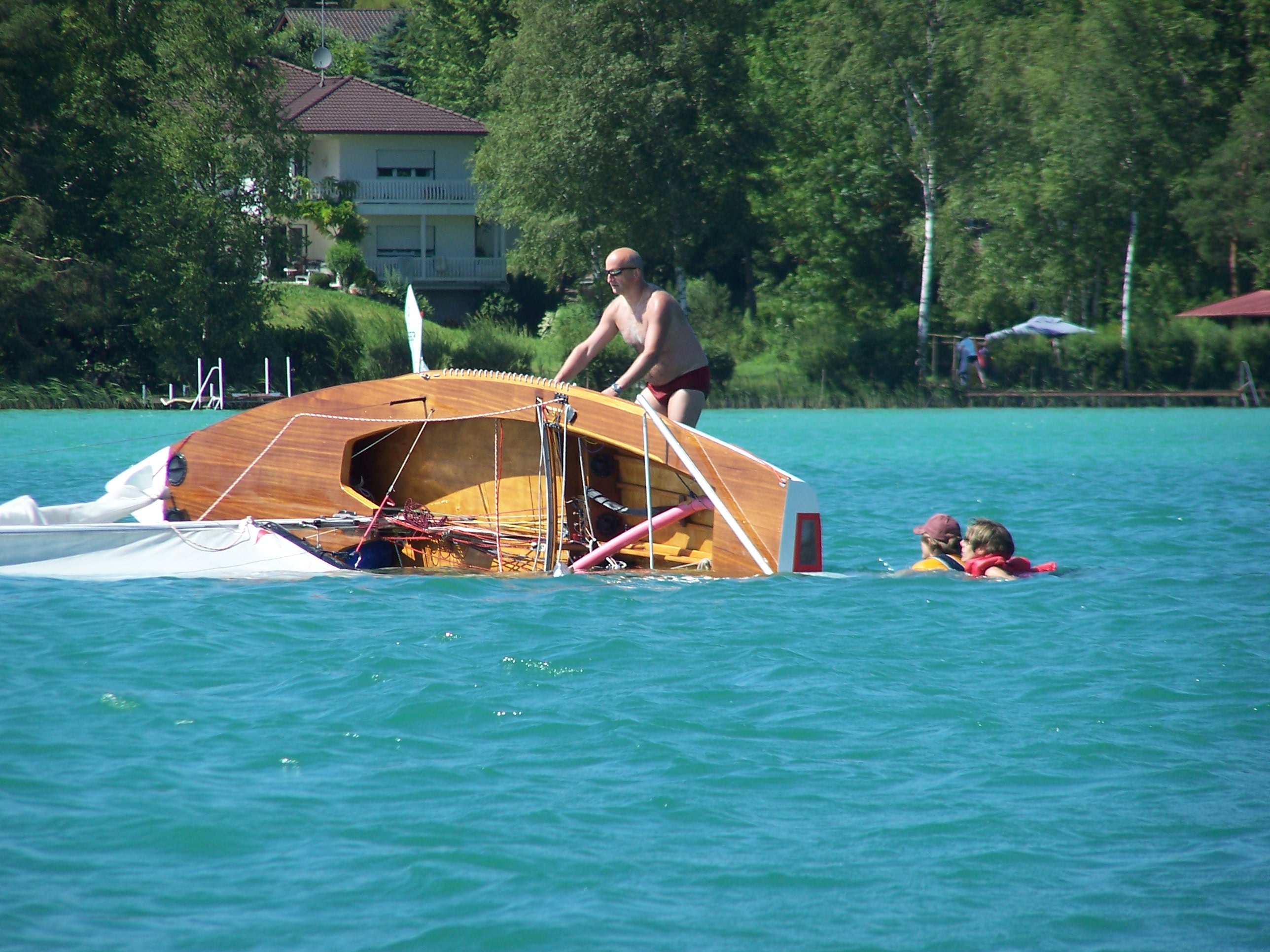
The boat is lying on its side. Weight on the centerboard will right the boat again.
It is precisely this interplay of wind and water that makes sailing possible.
The wind gives the force, the water gives the hold—and in between the boat glides forward.
But sometimes you also feel that this balance does not always remain perfect.
Because sailing is always a play of forces. The wind presses into the sails, the water holds against it below. And as long as both are in the right proportion, the boat stays upright and runs smoothly.
If the pressure of the wind suddenly becomes too strong—stronger than the boat and the water can balance—then this equilibrium tips.
The boat leans to the side. It capsizes.
And especially on a dinghy you should always be aware of this: When the boat suddenly lays over, not only can water get into the boat—loose items can also disappear quickly.
A bottle, a jacket, a phone, or a bag often drifts away faster than you can react. That is why it is worth stowing small items from the start so they cannot simply go overboard.
A waterproof bag that shows what should come along is always part of my kit. And everything important can be secured to the boat with a small line or a carabiner. That way, at least the essentials stay where they belong in an emergency.
Capsizing is part of dinghy sailing sooner or later.
Not because you do something wrong—but because a boat like the FD reacts quickly. A gust, a moment of inattention, a wrong movement—and suddenly the boat lies on its side or even upside down in the water.
For many beginners this sounds frightening at first. But with a little knowledge, capsizing quickly loses its terror.
The most important thing is: stay calm.
A sailboat usually capsizes unexpectedly, but it does not immediately become dangerous. In most cases there is even a simple rule:
The safest behavior is to stay with the boat.
Boats very rarely sink completely. Even if they fill with water, they usually remain afloat. And a boat on the water is much easier to see than a single person in the water. It is therefore always the best “rescue point,” especially when help has to come.
Of course, when capsizing, the mast can get stuck in the shallow lakebed. Sometimes you can right the boat alone, sometimes you need help. And that usually comes, too.
In such moments the lifeguards tow you free against the wind, and afterwards their drinks fund might appreciate a small contribution. And if for some reason that’s not the case, it’s good to know: the shore is not far. On a lake you can often swim to land in a short time, but it is still more sensible to stay with the boat first and sort out the situation.
Capsizing on inland waters is usually manageable.
At sea it is different: waves, currents, and greater distances play a much stronger role. That is why capsizing there is far more demanding and you have to plan more safety reserves.
When capsizing itself, there are a few things you should pay attention to.
For example, you must not jump uncontrollably into the sails. The material can tear, and damaged sails make righting harder later.
Also, after a capsize many lines float in the water—under the boat or around the sails. That is exactly why you should avoid hectic movements. Otherwise there is a risk of getting entangled. I always had respect for that.
If a line has to be released, do it slowly and deliberately. Often you can reach a lot from outside without having to dive under the boat.
Once you have collected yourself, the most important step follows:
Right the boat again.
To do that, the sail must first lie free in the water and not be pinned under the hull. Then you stand—simplified—on the centerboard, the board sticking out under the dinghy that normally prevents side slip.
Your body weight creates a lever that slowly rotates the boat back. As soon as the boat comes upright, it often rights itself surprisingly quickly.
The moment afterwards is usually the hardest: the boat is wet, everything is in disorder, maybe something is bent. But this is exactly where experience helps:
Don’t grab everything at once. First orient yourself. Count the crew. Breathe.
Capsizing is no drama. It is good to have a second set of clothes that has stayed dry.
Many sailors even say: once you have capsized, you sail more relaxed afterwards. Because you suddenly know: it happens—and you can handle it. And in fact this doesn’t just apply to sailing. Often in life the fear of the event is greater than the event itself.
With a clear head, you don’t need to be afraid while sailing.
Capsizing is not the end.
It is part of learning.
Crew
A Flying Dutchman is normally sailed by two people. The boat is designed so that the tasks are divided: one steers as skipper, the other works in front with the sails—the crewman, sometimes jokingly called the “Fokaffe.”
Especially in sporty maneuvers, this cooperation is needed. An FD reacts quickly, demands attention, and lives from both people on board doing the right thing at the right moment.
Nevertheless I often went out alone, because this form of sailing appealed to me. Sailing alone means you have to have everything in your own hands: hold course, handle the sails, balance the boat—and never lose sight of the wind.
It is a challenge I sought.
You sail closer to your own limit, you get wet, you make mistakes—or you experience those rare moments when suddenly everything fits. Wind, speed, and feeling interlock, and the boat glides exactly as you wish.
Sometimes you even notice that others are watching. Even experienced regatta sailors watch curiously when someone tries to handle such a demanding boat alone.
Over the years you collect many small experiences. Only recently, for example, I got the idea of briefly securing the rudder system with a bungee cord during a gybe. A bungee cord is basically nothing more than an elastic band that keeps the rudder in position while you have to go forward.
Because when setting the spinnaker—the large, colorful sail for downwind—you work far forward on the boat, where the spinnaker pole is also attached. In those moments every small help that brings calm into the boat counts.
Of course, sailing doesn’t always remain without traces.
After some hours my crewwoman or I had bruises, muscle soreness, scrapes, and blisters on our hands. But they were never serious injuries—rather small signs that sailing not only looks beautiful, but is also a sporty craft.
Sometimes I was even more worried about the boat than about myself.
Once a strong guy sailed with me—you could call him a bodybuilder—who hauled on the jib sheet as if he were lifting weights. I had to remind him every time that this was an old wooden boat and not every fitting can withstand raw force.
That is why it is often an advantage for me to sail with a lighter, more agile crewman. Because it doesn’t depend on strength—but on feel, timing, and agility, which often matter more on such a boat than pure power.
I was always pragmatic about sails as well.
I only bought new sails once, mainly for class regattas. Most of the time, used sails were perfectly sufficient. Regatta professionals regularly sort out their sails, and for me that was often the best solution—to acquire them.
In 35 years, a sail ripped twice. It hurts in the first moment, but then you improvise. Another time the retractable rudder broke from too much pressure.
Since then I pay more attention to not putting maximum power everywhere. Not too much tension in the shrouds, not too much pressure on the rudder, not too much fighting against the wind.
Because in the end you often sail more beautifully when you sail more relaxed.
The boat glides more easily over the waves when you don’t constantly force it, but accompany it.
Once I even returned to the slipway with a defective rudder system using a paddle—to the place where the boat is pulled out of the water. Sailing also means: stay calm, find solutions, and make your way back without haste.
And perhaps that is exactly what is special about it.
Sailing is sporty, sometimes wet, sometimes demanding—but above all it is a feeling of freedom that has accompanied me for decades.
Twice my shrouds snapped. But with a bit of ingenuity I could prevent the mast from falling completely. And in the end only one thing mattered: the boat must work again.
Sailing sometimes reminds me of riding a motorcycle. If you go too fast into a curve, you tip over. The difference is: on the water you fall softly.
Glossary
Parts of the Boat
- Bug – Front part of the boat.
- Achter – Rear part of the boat (stern).
- Mast – Vertical spar to which the sails are hoisted.
- Schwert – Board under the boat that prevents sideways slipping (centerboard).
- Schwertkasten – Box in the boat that holds the centerboard.
- Ruderanlage – Steering system (rudder blade + tiller).
- Pinne – Tiller, the lever used to move the rudder.
- Traveller – Track on which the boom can be adjusted sideways.
- Slipanlage – Place or ramp at the shore where the boat is launched.
Sails and Lines
- Großsegel – Mainsail.
- Vorsegel (Fock/Genua) – Foresail in front of the mast.
- Genua – Especially large foresail (genoa).
- Spinnaker (Spi) – Large, colorful sail for wind from behind or slightly aft.
- Spinnakerbaum – Pole that holds the spinnaker outwards.
- Schoten – Sheets used to trim the sails.
- Vorschot – Sheet used to trim the foresail (jib sheet).
- Lieken – Edges of a sail:
- Vorliek (front)
- Unterliek (bottom)
- Achterliek (back)
- Keep – Groove in the mast into which the mainsail is fed.
- Cunningham – Line used to tension the luff of the mainsail.
- Niederholer – Line that pulls the boom down and flattens the sail.
Wind and Orientation
- Windstärke (Beaufort/bft) – Measure of wind strength.
- Böe – Sudden gust of wind.
- Verklicker/Stander – Wind indicator at the masthead.
- Luv – The side from which the wind comes (windward).
- Lee – The side away from the wind (leeward).
- Spione – Small wool threads on the sail that indicate airflow (telltales).
- Kielwasser – The boat’s wake.
Directions on the Boat
- Steuerbord – Right side of the boat in the direction of travel (starboard).
- Backbord – Left side of the boat in the direction of travel (port).
Maneuvers and Movement
- Manöver – Planned action with the boat (e.g. tack, gybe, moor).
- Wende – Turn with the bow through the wind to change sides (tack).
- Halse – Turn with the stern through the wind (usually stronger than a tack) (gybe).
- Abfallen – Turn away from the wind (bear away).
- Anluven – Turn toward the wind (head up).
- Kentern – Boat capsizes and lies on its side or upside down.
- Krängung – Heel, the boat’s angle caused by wind pressure.
Crew and Sailing Practice
- Skipper/Steuermann – Person who steers the boat.
- Vorschoter/Vorschotter – Crew member in front, handles foresail and spinnaker.
- Trapez – Device to hang outside the boat and provide counterweight.
- Regatta – Sailing race.
- Klassenregatta – Regatta where all boats sail the same class.
- FD (Flying Dutchman) – Sporty racing dinghy (boat class in the book).
Safety and Everyday Life on the Water
- Boje – Floating marker or mooring point.
- Anker – Weight on rope/chain used to hold the boat.
- Steg – Structure at the shore for mooring and boarding.
- Dichtholen – Pull a sheet in tighter.
- Fieren/Vieren – Ease a sheet, open the sail.